
What if the most important feature of a DeFi wallet were not the number of networks it supports, but its ability to make an opaque transaction legible before money moves? That question matters whenever a user in Germany moves between Ethereum, an optimistic rollup, a sidechain, and a bridge in the same afternoon. The interface may look familiar, yet each approval, contract call, and fee creates a different risk surface. Rabby Wallet approaches this problem as a non-custodial wallet and transaction-checking layer designed around EVM-based DeFi. Its central promise is not that users can avoid complexity, but that more of that complexity can be inspected before confirmation.
This distinction is easy to miss. A wallet does not decide whether a protocol is economically sound, whether a token will retain value, or whether a bridge is trustworthy. It manages keys, presents transaction data, connects applications, and helps the user interpret what a signature may do. Rabby’s value therefore lies in the quality of that interpretation: simulation, warnings, network handling, and a workflow aimed at reducing avoidable mistakes without pretending that software can remove all uncertainty.
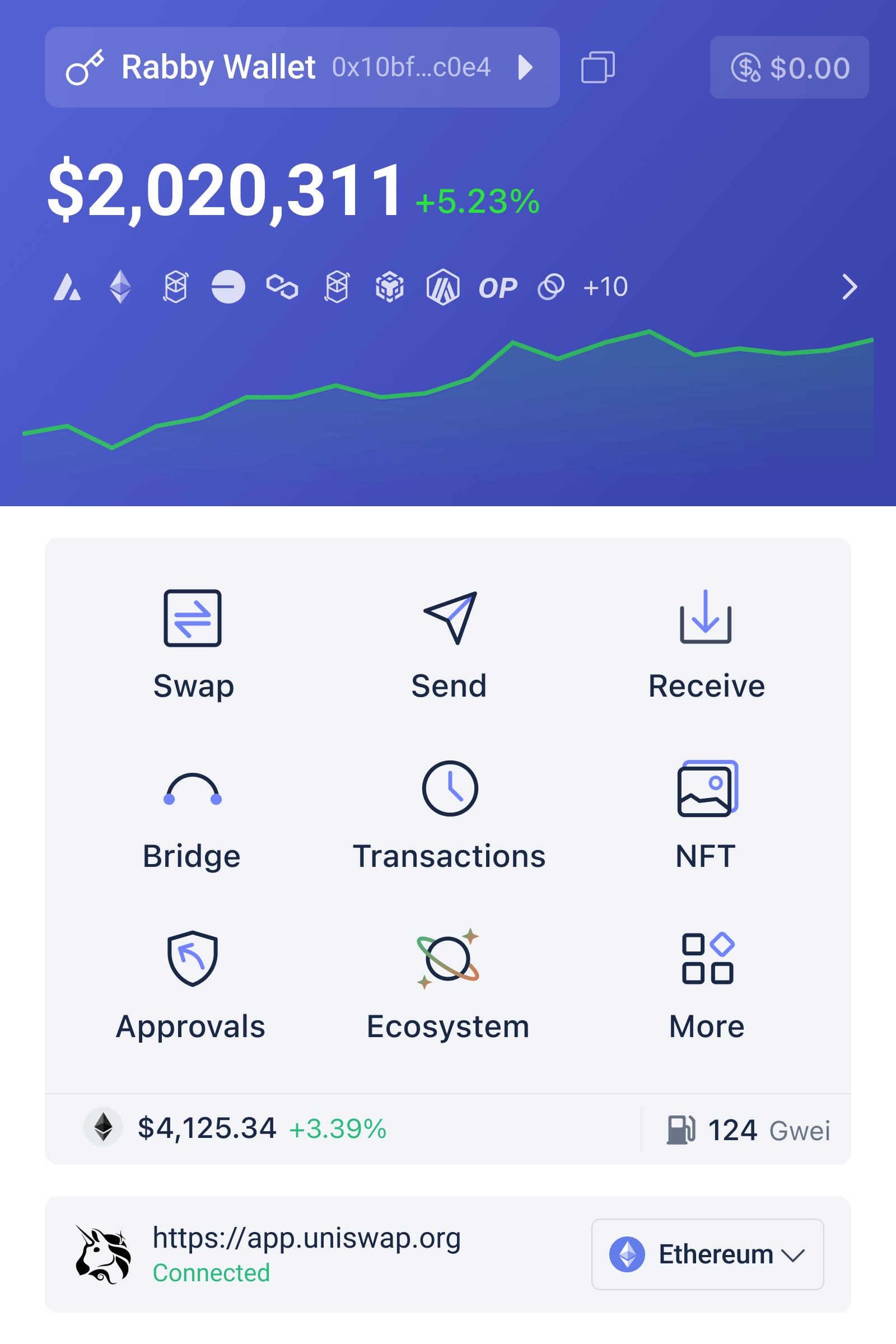
A practical case: one afternoon, four chains, several different risks
Consider a user who deposits USDC into a lending market on Arbitrum, swaps an asset on Ethereum, bridges funds to Base, and later connects to a new yield application. In a conventional mental model, these are simply four wallet actions. Technically, they are different classes of interaction. The lending deposit may require a token approval followed by a supply call. The swap depends on routing and slippage. The bridge introduces an intermediary protocol and a cross-chain settlement process. The yield application may ask for permissions whose consequences are not obvious from its front end.
Rabby supports more than 140 EVM-compatible networks, including Ethereum, Polygon, Arbitrum, Optimism, Avalanche, Base, and BNB Chain. Its automatic network switching can remove a common source of friction: signing while connected to the wrong chain or manually changing networks in the middle of a workflow. That convenience is useful, but it should not be confused with a security guarantee. Correct network selection answers “where will this call be sent?” It does not answer “what will the contract do?”
The more important layer is transaction simulation. Before signing, Rabby attempts to show the expected changes to token balances and the transaction’s effects. This creates a sharper decision point than a generic request to “confirm.” If a supposed claim transaction appears to transfer valuable assets, or a swap produces an unexpected approval, the discrepancy becomes visible before the private key authorizes it.
That is a meaningful improvement in the user interface because blockchain signatures are often irreversible in practice. Yet simulation has a boundary. It is a forecast of execution under particular conditions, not a legal or economic audit of the protocol. State can change, contracts can behave differently under unusual conditions, and a simulation may not capture every social-engineering risk. The right mental model is therefore “an additional inspection instrument,” not “an automatic insurance policy.”
Security begins with separation of responsibilities
Rabby was developed by DeBank and is positioned as a DeFi-focused alternative to MetaMask. Its non-custodial design means private keys are stored locally on the user’s device rather than sent to Rabby’s servers. This is an important boundary: the service can provide interface features and security intelligence, but it does not hold the keys in the custodial sense.
Rabby also describes itself as an independent checker rather than an engine that invents or alters the user’s transactions. The signing function can remain available even if Rabby’s backend services are unavailable, although features that depend on external information may be reduced. This separation is conceptually valuable. It distinguishes the wallet’s role as a verifier and signer from the dApp’s role as the party requesting an action.
An integrated security scanner checks contracts and addresses for signals associated with phishing, known hacks, and unlimited token approvals. An unlimited approval allows a contract to spend a token from a wallet up to a broad allowance, sometimes indefinitely. Such approvals can be convenient, but they enlarge the damage that may follow if a contract is compromised or the user interacted with a malicious address. A warning can interrupt that chain of events.
Still, warning systems are necessarily dependent on available knowledge and detection logic. A new exploit may not yet be classified. A legitimate contract may carry complex risks that a simple label cannot express. Open-source code, released under the MIT licence, improves the possibility of independent inspection, but it does not mean every user can personally audit the implementation or every supported protocol. Transparency is an opportunity for scrutiny, not proof that scrutiny has occurred.
Multi-chain convenience creates a new kind of cognitive risk
Supporting many networks solves one problem while intensifying another. It becomes easier to access liquidity and applications, but the user must track chain-specific gas assets, bridge routes, token representations, contract addresses, and differing levels of protocol maturity. In Germany, where users may already separate exchange records, wallet activity, and tax documentation, a wallet that simplifies execution can also make activity feel deceptively uniform.
Rabby’s integrated bridge functionality, including routes through LI.FI, and its swap aggregator, which can scan venues such as Uniswap and 1inch, reduce the need to move between multiple interfaces. The same applies to the Gas Account feature, which can allow transaction fees to be paid with stablecoins such as USDC rather than requiring the native token of each network. These features address a real usability problem: a user may possess the asset they want to transact with but lack a small amount of the chain’s gas token.
The trade-off is abstraction. Aggregation can improve convenience and potentially routing, but the user is still exposed to the risks of the underlying venues, bridges, liquidity conditions, and execution assumptions. A lower displayed slippage estimate is not the same as a risk-free trade. Likewise, paying gas in a stablecoin hides the operational detail of fee conversion; it does not eliminate fees or guarantee that the account service will always be available.
A useful rule is to treat convenience features as routing tools, not as trust substitutes. Before a large transaction, inspect the destination, the asset received, the approvals requested, the network selected, and the final balance changes. If the action is unfamiliar, test with a small amount. This procedure remains valuable even when a wallet presents a reassuring interface.
Where Rabby fits in a serious wallet setup
For a user who interacts with several EVM applications, a browser-based Rabby Chrome extension can function as an operational dashboard: it recognizes the dApp’s network, displays transaction effects, scans for known warning signals, and keeps signing under the user’s control. The wallet is also available across Chrome, Brave, and Edge, with desktop versions for Windows and macOS and mobile applications for iOS and Android. Readers assessing the rabby wallet should nevertheless verify software authenticity through official distribution channels and protect the recovery phrase as the ultimate authority over the account.
Hardware-wallet compatibility with Ledger, Trezor, and OneKey adds another layer. A hardware device protects the signing key from ordinary browser compromise, while Rabby can improve the context in which a transaction is reviewed. These protections address different failure modes. Hardware signing does not make a malicious transaction safe; it makes unauthorized extraction of the key harder. Simulation does not protect a user who ignores an unexpected result; it improves the information available at the signing moment.
Rabby Points, earned through activities such as swaps, gas top-ups, or referrals, introduce a loyalty and engagement mechanism. That may encourage users to explore wallet features, but incentives can also change behaviour. A user should not perform unnecessary transactions merely to accumulate points, especially when each interaction creates fees, approvals, smart-contract exposure, and potential record-keeping implications. In DeFi, the cheapest transaction is often the one that was never needed.
What to watch as wallet interfaces become more interpretive
The recent Chrome Web Store description presents Rabby as an open-source Ethereum and EVM wallet focused on a smooth multi-chain experience and protection for DeFi users. The more significant direction behind that wording is the movement from passive key containers toward interpretive transaction interfaces. If simulations become more accurate, warnings more specific, and cross-chain explanations clearer, wallets may help users reason about actions rather than merely approve them.
That scenario depends on several conditions: reliable data about contracts and addresses, transparent handling of uncertainty, careful integration of third-party routing services, and users who continue to inspect rather than blindly accept prompts. The unresolved question is not whether a wallet can show more information. It is whether that information can remain understandable when transactions involve multiple calls, changing liquidity, permissions, and cross-chain dependencies.
The practical conclusion is modest but useful. Rabby is best understood as a security-oriented inspection and signing environment for EVM DeFi, not as a substitute for protocol research or personal custody discipline. Its strongest contribution is the separation between “the dApp requested something” and “the user can see what is expected to happen.” That gap is where many preventable mistakes begin—and where better wallet design can make the largest difference.
Frequently asked questions
Is Rabby a custodial wallet?
No. Rabby follows a non-custodial model in which private keys are stored locally on the user’s device and are not sent to Rabby’s servers. The user remains responsible for the recovery phrase, device security, and every signature.
Does transaction simulation guarantee that a transaction is safe?
No. Simulation can show expected balance changes and expose suspicious approvals or outcomes before signing, but it cannot guarantee that a protocol is solvent, honest, bug-free, or immune to future state changes. It should be treated as an important check within a broader security process.
Why is multi-chain support useful for DeFi users in Germany?
It reduces the need to manage separate wallet interfaces across EVM networks and can simplify access to applications, swaps, bridges, and fee management. The trade-off is that users must still understand which chain they are using, how assets are represented there, and what risks belong to the underlying protocol.