
What if the most dangerous moment in DeFi is not signing a transaction, but misunderstanding what the transaction will do? A familiar wallet prompt may show a contract address, a gas estimate, and a button labelled “Confirm,” yet none of those details necessarily explains how the action will change your portfolio. For users in Germany and across the wider European DeFi community, this is an important distinction. Multi-chain activity is becoming easier, while the underlying systems are becoming harder to inspect. A wallet therefore needs to do more than hold keys: it should help users interpret intent before that intent becomes an irreversible blockchain state.
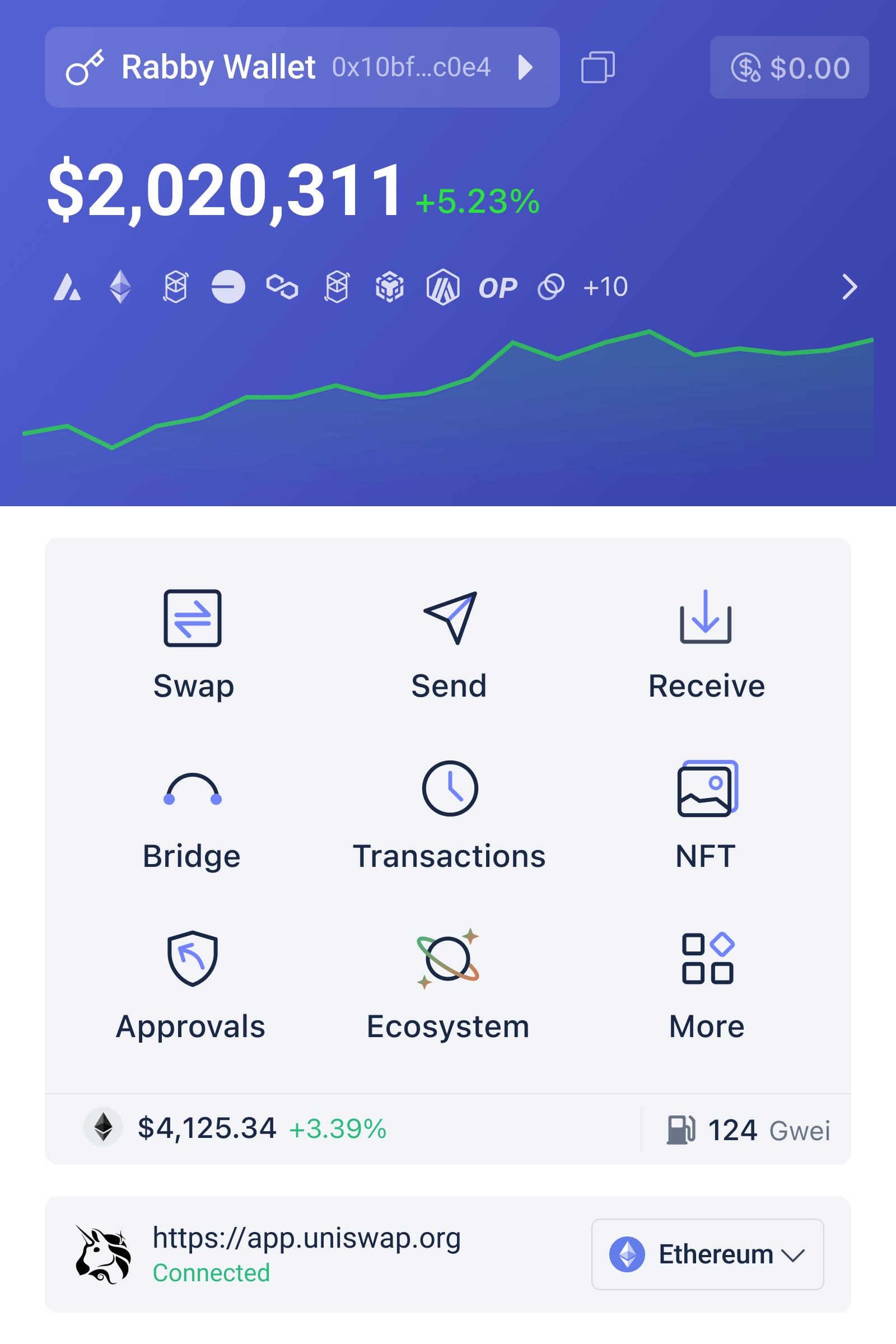
That is the central idea behind Rabby. Developed by DeBank as a non-custodial wallet for DeFi users, it is designed around multi-chain interaction, security warnings, and pre-signing transaction simulation. Its recent Chrome Web Store presentation describes it as an open-source Ethereum and EVM wallet focused on a smoother multi-chain experience. The useful question, however, is not whether Rabby is “safer” in the abstract. The better question is which risks its architecture can reduce, which risks remain outside its reach, and how a user should read the information it provides.
The first misconception: a wallet is not the transaction
A non-custodial wallet does not take possession of a user’s assets in the way a centralized exchange does. The private keys remain locally stored on the user’s device and are not sent to Rabby’s servers. When a decentralized application requests an action, the wallet presents data for review and, after approval, uses the key to produce a digital signature. The blockchain then evaluates the signed message according to the relevant smart contract rules.
This separation matters. Rabby does not independently create or alter the user’s transaction. It acts more like an inspection layer between a dApp and the signer. Its core signing functions are intended to remain usable even if Rabby’s backend services are unavailable. That does not mean every surrounding feature works offline, nor does it remove the responsibility of checking what is being signed. It means the wallet’s role is not equivalent to a custodian or an intermediary that can rewrite the final action.
For Chrome, Brave, or Edge users looking for a practical starting point, the rabby wallet extension brings this review-oriented workflow into the browser. The convenience is important, but convenience should not be confused with automatic safety. A browser extension still depends on the security of the computer, the authenticity of the installation source, and the user’s handling of recovery material.
Transaction simulation: from “what am I signing?” to “what should change?”
Transaction simulation is the most instructive feature to understand. A standard wallet prompt often describes an instruction at the technical level: call a contract, approve a token, or transfer an asset. A simulation instead attempts to execute the proposed call in a preview environment and report the expected state changes. In practical terms, the user may see which tokens are expected to leave the wallet, which assets should arrive, and whether an approval is being granted.
This changes the mental model of signing. The question is no longer merely whether the destination address looks familiar. It becomes: does the predicted result match the economic action I intended? If a user wants to swap one stablecoin for another but the preview indicates a valuable token leaving without a corresponding receipt, that mismatch is a strong reason to stop. Likewise, an “infinite approval” warning can reveal that a contract is being given broad future permission rather than permission limited to the current amount.
Simulation is especially valuable because DeFi transactions are often bundled. A single signature can involve a router, a token contract, a liquidity pool, and several internal calls. The visible dApp interface may simplify this complexity, while the blockchain processes all of it. The simulation does not make the contract simpler; it makes some of its expected consequences more legible before the signature is produced.
Why the preview is powerful but not magical
A simulation is an estimate based on the transaction’s current conditions and the environment used for the preview. State can change between simulation and mining. Prices may move, liquidity may disappear, a block may alter a pool’s reserves, or a contract may behave differently under another execution context. Some contracts also contain logic that is difficult to model perfectly. A successful preview is therefore evidence that the proposed call appears consistent with the expected state, not a guarantee of profit, execution, or safety.
This boundary is easy to miss. A malicious contract can produce a technically coherent result while still offering an economically harmful deal. A bridge may deliver an asset on another network but expose the user to bridge, liquidity, or counterparty risks. A token can arrive in the wallet and still be difficult to sell. Simulation can expose expected movements; it cannot replace research into protocol design, token legitimacy, governance, or market depth.
Security scanning and the value of friction
Rabby’s integrated security engine adds another layer by checking contracts and addresses for signals associated with phishing, known exploits, or risky token approvals. These warnings are useful because many losses begin with a plausible-looking interaction rather than an obviously suspicious one. A cloned website, a compromised contract, or a request for excessive allowance can appear ordinary to a user who is moving quickly.
The key concept is not “the wallet blocks all bad transactions.” It is “the wallet introduces informed friction.” In behavioural terms, a warning creates a pause at the point where haste is costly. That pause is most effective when the user understands what the warning means and knows whether the proposed action is necessary. Open-source software, released under the MIT licence, also permits independent inspection of the code, although open source alone does not prove that every dependency, release process, or user environment is secure.
Hardware-wallet support can strengthen the arrangement. Ledger, Trezor, and OneKey devices keep key operations behind a separate signing boundary, reducing the chance that malware on a computer can simply extract the private key. They do not, however, prevent a user from approving a harmful transaction on the hardware device. The security improvement is strongest when hardware isolation is combined with careful transaction review, not when the device is treated as a substitute for understanding.
Multi-chain convenience creates a new category of risk
Rabby supports more than 140 EVM-compatible networks, including Ethereum, Polygon, Arbitrum, Optimism, Avalanche, Base, and BNB Chain. Automatic network switching can remove an annoying source of user error: manually selecting the correct chain before connecting to a dApp. Integrated bridges, including access to protocols such as LI.FI, can also make moving assets between networks feel like a single wallet operation.
Yet abstraction has a trade-off. The more the interface hides network differences, the easier it becomes to forget that assets on separate chains are not interchangeable merely because they share a symbol. A token on one network may have a different contract address, liquidity profile, or issuer representation on another. A bridge transaction may involve several protocols and an additional set of operational assumptions. A clean interface is helpful, but the user still needs to know which network holds the asset, where it will arrive, and whether the receiving application supports that representation.
The Gas Account feature illustrates the same balance. Paying network fees with stablecoins such as USDC can solve a common practical problem: holding the correct native token on every chain. For a user moving between Ethereum-layer networks, that can reduce operational friction. But fee abstraction can also hide the underlying cost structure. Users should still inspect the fee, the route, and the service conditions rather than assuming that paying in a stablecoin makes a transaction inexpensive or risk-free.
A reusable framework for reviewing any DeFi transaction
Before signing, a useful four-part check is more reliable than a single “safe” label. First, identify the intended economic action: swap, deposit, withdrawal, approval, bridge, or claim. Second, compare that intention with the simulated balance changes. Third, inspect permissions: is the approval limited, and does the receiving contract belong to the protocol you intended to use? Fourth, consider the boundary conditions, including slippage, network, bridge exposure, and whether the asset received is liquid and recognised by the destination application.
This framework also corrects a subtle misconception. Transaction security is not a property of the wallet alone. It is a relationship among the wallet, the dApp, the smart contract, the current blockchain state, the user’s device, and the user’s interpretation of the prompt. Rabby can improve the information available at the signing boundary, but it cannot turn an experimental protocol into a mature one or guarantee that a market price will remain favourable.
For German users, this matters beyond technical curiosity. DeFi activity often crosses jurisdictions, networks, and service providers, while tax records and personal portfolio tracking still require precise distinctions between swaps, transfers, rewards, and bridges. Features such as Rabby Points may make interactions more engaging, but loyalty incentives should not determine whether a transaction is economically sensible. The right priority remains clear: understand the action first, evaluate costs and risks second, and treat points as incidental rather than as a reason to transact.
What to watch next
The most meaningful development to monitor is not simply whether wallets add more networks. It is whether they can present increasingly complex execution paths without creating false confidence. If simulations become more accurate, warnings more contextual, and cross-chain routes easier to compare, wallets may function less like passive signature tools and more like user-facing risk interpreters. That scenario depends on reliable data, transparent assumptions, and interfaces that show uncertainty rather than hiding it.
The opposing risk is equally plausible: more automation may encourage users to approve actions they no longer understand. Automatic network switching, bundled routes, stablecoin-based gas, and one-click bridging are useful precisely because they remove steps. Removing steps can reduce mistakes, but it can also remove moments of reflection. The best design will therefore not eliminate friction entirely; it will place friction where it protects the user and remove it where it merely causes confusion.
FAQ: Rabby, Chrome, and transaction simulation
Is Rabby a custodial wallet?
No. Rabby is designed as a non-custodial wallet: private keys are stored locally on the user’s device rather than transmitted to Rabby’s servers. The user remains responsible for protecting the device, recovery phrase, and signing decisions.
Does transaction simulation guarantee that a transaction is safe?
No. It previews expected state changes and can reveal mismatches, suspicious approvals, or unexpected asset movements. It cannot guarantee contract integrity, future execution conditions, bridge solvency, token liquidity, or a profitable outcome.
Why use a hardware wallet with a DeFi browser extension?
A hardware wallet adds a separate key-protection boundary, making private-key extraction more difficult. It does not decide whether a transaction is wise, so the user should still review the destination, permissions, network, fees, and simulation before confirming.
What is the most important habit when using Rabby on multiple chains?
Match the intended action with the simulated result and verify the network and token contract. Multi-chain interfaces reduce operational clutter, but they do not remove differences in liquidity, bridge risk, asset representation, or transaction costs.
A capable DeFi wallet should make signing more intelligible, not merely faster. Rabby’s combination of local key custody, security scanning, hardware-wallet compatibility, broad EVM support, and transaction simulation offers a strong review workflow for users who move across networks. Its real value appears when the user treats the preview as a question to investigate rather than a certificate of safety. In DeFi, that distinction is small in wording and large in consequence.